Subterranean termites navigate upward from regional soils into historic framing, entering through hairline foundation fissures, stone mortar joints, and utility penetrations. In older housing stock throughout Tremont,…
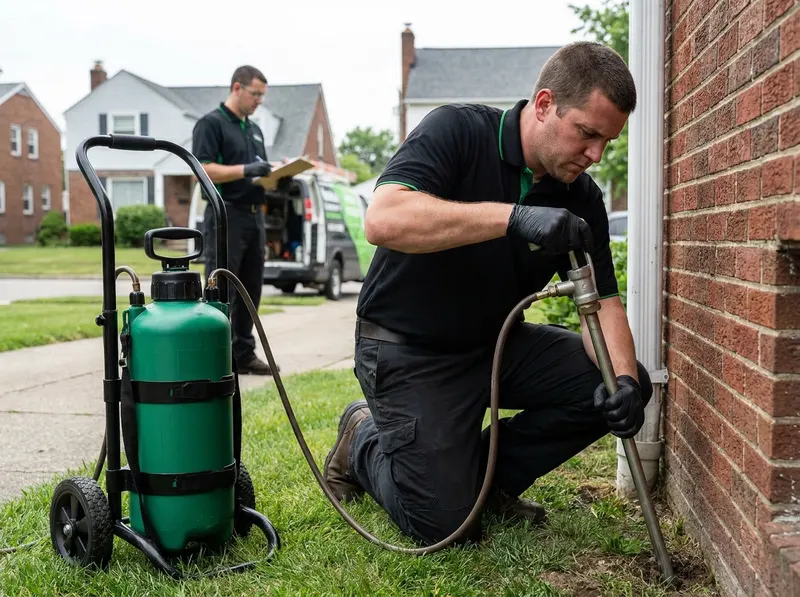
Subterranean termites navigate upward from regional soils into historic framing, entering through hairline foundation fissures, stone mortar joints, and utility penetrations. In older housing stock throughout Tremont, Ohio City, and Detroit-Shoreway, balloon-frame construction and porous sandstone footings provide direct channels from subterranean nesting zones into ground-level sill plates. Liquid non-repellent treatments use termiticides compliant with the US EPA Safepestcontrol guidelines, establishing continuous horizontal and vertical chemical zones directly where soil meets masonry. The liquid chemistry transfers across foraging workers without triggering avoidance behaviors, ensuring the active compound penetrates the deep subterranean brood chambers situated well beneath the frost line.
Deciding between liquid soil barriers and non-invasive perimeter bait networks depends directly on foundation masonry and ground access. Properties in Old Brooklyn, Kamm's Corners, and Slavic Village featuring full concrete basement slabs benefit from liquid perimeter trenching paired with interior slab injection, which stops active foragers within 90 days. Conversely, residences adjacent to Lake Erie moisture corridors in Edgewater and Collinwood, or properties in University Circle and Glenville with decorative brick terraces, frequently require baiting systems adhering to National Pest Management Association technical standards. Baiting preserves surrounding hardscaping while consuming 6 to 12 months to achieve complete colony elimination through targeted chitin synthesis inhibitors.
Technicians follow a systematic execution sequence to ensure continuous chemical barriers without disrupting indoor air quality.
Treatment application protocols align strictly with building safety standards from the International Code Council and federal exposure metrics under the National Institute for Occupational Safety and Health. Structural wood timbers that show minor surface damage are preserved using localized borate salt infusions documented by the USDA Forest Service, halting fungal decay and insect digestion simultaneously. Site preparations comply with urban excavation boundaries from the Cuyahoga County engineering office, safeguarding groundwater drainage networks while eliminating hidden insect activity. Technical inquiries and scheduling arrangements are managed by calling (216) 682-2079.
Every job gets a firm, written price after an on-site visit.
Tell us about your subterranean termite treatment job in Cleveland and we'll send a clear, written quote, usually the same day.
 Elmwick Extermination