Older multi-family framing and historic double-houses across Ohio City, Tremont, and Detroit-Shoreway often house deep insect aggregations behind plaster and lath. Traditional broadcast aerosol sprays repeatedly fail…
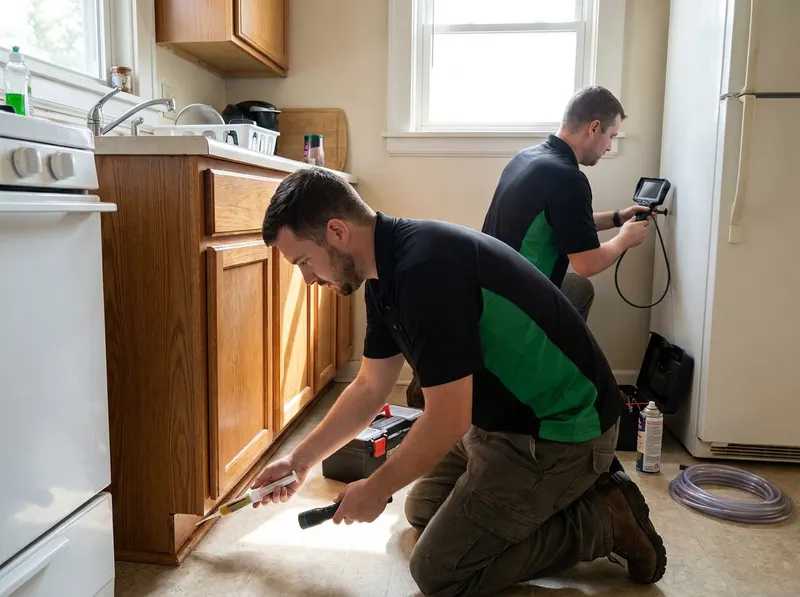
Older multi-family framing and historic double-houses across Ohio City, Tremont, and Detroit-Shoreway often house deep insect aggregations behind plaster and lath. Traditional broadcast aerosol sprays repeatedly fail in these architectural environments because synthetic pyrethroids trigger avoidance behavior, scattering female roaches carrying viable oothecae deeper into unconditioned subfloors. Cockroach baiting and void inversion changes this vector. Void inversion injects micro-dosed non-repellent formulations directly into enclosed pipe chases and wall cavities. This procedure alters the harborages' microclimate, forcing the insects out into controlled interception pathways where dense, moisture-rich bait matrices wait behind appliance panels.
Technicians treat kitchen framing and wet walls according to standards established by the U.S. Environmental Protection Agency for indoor targeted pesticide application. In neighborhoods like Old Brooklyn, Kamm's Corners, and Edgewater, shared plumbing lines in multi-story brick duplexes frequently transfer pests between kitchens. Direct structural placement prevents cross-contamination of dishes, food prep counters, and pantry goods. For multi-family properties along University Circle and Glenville, targeted feeding disrupts insect development by leveraging secondary transfer mechanics outlined in research by the Entomological Society of America. Surviving nymphs consume bait-laden excretions inside subterranean aggregation zones, collapsing the colony without ambient broadcast chemicals hanging in living areas.
Implementation follows a disciplined five-step remediation sequence:
Properties near high-moisture lakefront regions in Collinwood and Slavic Village often present Oriental cockroach activity in damp basements, demanding a different formulation than interior German cockroach infestations. Guidance from the Centers for Disease Control and Prevention Healthy Pets program underscores the critical balance of placing bait reservoirs out of pet and human contact zones while remaining directly accessible to nocturnal pest tracks. Structural interventions align with non-invasive maintenance practices published by the BuildingGreen Sustainable Design collective and environmental guidelines from the Cuyahoga County Government. Property protection standards mirror structural integrity criteria from the International Code Council, preventing degradation of wall framing while controlling indoor allergens overseen by the Asthma and Allergy Foundation of America. Structural conditions, ambient room temperature, and moisture levels govern the initial knockdown rate, with full colony collapse completed within 14 to 21 days.
Every job gets a firm, written price after an on-site visit.
Tell us about your cockroach baiting and void inversion job in Cleveland and we'll send a clear, written quote, usually the same day.
 Elmwick Extermination