Elmwick ExterminationElmwick Extermination

Carpenter Ant Colony Elimination Cleveland

Carpenter ant colony elimination requires an exacting diagnostic approach across Cuyahoga County's historic housing inventory. Unlike termites, Camponotus pennsylvanicus workers do not consume wood fibers; instead,…
Get My Estimate →(216) 682-2079
Carpenter Ant Colony Elimination in Cleveland, oh
Quick answer
  • What is included: Comprehensive acoustic moisture mapping, parent nest tracing, targeted void injection of non-repellent transfer chemistry, and structural perimeter barrier establishment.
  • Service timeframe: Initial inspections and treatments average 90 to 120 minutes on-site, with complete colony death occurring within 14 to 21 days.
  • Pricing parameters: Residential treatments range from $200 for localized satellite nest suppression to $650 for severe, multi-nest structural infestations; exact costs are confirmed on-site.
  • Targeted materials: High-moisture framing sill plates, band joists, window headers, porch columns, and exterior tree cavities harboring satellite colonies.
  • Direct contact: Service scheduling and technical protocol confirmation are completed via phone at (216) 682-2079.

Carpenter ant colony elimination requires an exacting diagnostic approach across Cuyahoga County's historic housing inventory. Unlike termites, Camponotus pennsylvanicus workers do not consume wood fibers; instead, they excavate gallery networks through water-damaged structural timbers to rear brood. In historic balloon-framed properties across Ohio City, Tremont, and Detroit-Shoreway, these galleries frequently nest inside original damp subflooring, wall studs, and porch structural supports. Our team utilizes directional non-repellent formulations and micro-injection equipment registered under the EPA Federal Insecticide, Fungicide, and Rodenticide Act to safely dismantle parent nests hidden behind drywall without aerosolizing toxic residues across residential living spaces.

Structural moisture remains the primary catalyst for active infestations along Lake Erie microclimates. In lakefront districts such as Edgewater and Collinwood, wind-driven moisture penetrates masonry lintels, while early 20th-century residential structures in Old Brooklyn, Slavic Village, and Glenville often conceal chronic plumbing leaks behind plaster lath. When field technicians trace carpenter ant trails, we identify the high-moisture timber intersections prioritized by the International Association of Certified Home Inspectors for moisture testing. Applying over-the-counter pyrethroid sprays scatters foraging workers into uninfested structural bays, a physiological response known as colony budding. Successful elimination relies entirely on slow-acting biological disruptors governed by the Pest Control Technology guidelines, permitting returning foragers to distribute active transfer agents into the heart of the primary queen gallery.

Eradicating these wood-destroying colonies follows an established, clinical sequence to permanently clear the home:

  1. Step 1 is Acoustic and Moisture Assessment: Technicians use non-destructive surface meters to locate damp structural framing members across crawlspaces, basements, and second-story rooflines.
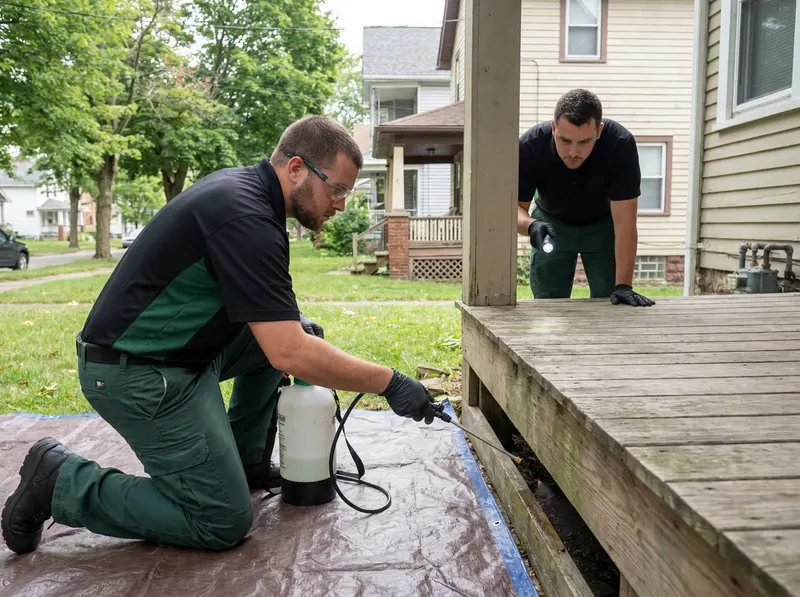
  2. Step 2 is Structural Void Injection: Technicians drill calibrated 1/8-inch access points into affected wall plates to inject non-repellent dusts directly into identified nesting galleries.
  3. Step 3 is Exterior Satellite Tracing: Exterior sweeps identify satellite pathways ascending from mature oaks or landscape ties into eaves, gutters, and trim boards.
  4. Step 4 is Perimeter Soil-Timber Barrier Application: Technicians apply non-detectable perimeter applications adhering to the environmental guidance of the Ohio Department of Agriculture Pesticide Regulation division.
  5. Step 5 is Structural Moisture Correction Verification: A final assessment evaluates exterior grade clearances, vegetation contact, and gutter discharge routes to prevent colony re-establishment.

Deciding between targeted void treatments and whole-structure exclusion treatments depends on colony maturity. A localized satellite nest occupying a bathroom header in Kamm's Corners or University Circle requires localized void injection, avoiding structural disruption. Conversely, multi-satellite infestations migrating between exterior tree cavities and interior sill plates require whole-perimeter barrier chemistry and arbor exclusion. The trade-off centers on project scope: targeted void injection delivers immediate disruption to indoor satellite galleries, while continuous perimeter barriers guarantee protection against foraging workers traveling up to 300 feet from outside ground sources. Elmwick Extermination adheres strictly to the structural standards outlined by the National Pest Management Association, the worker health protections of the Occupational Safety and Health Administration, the ecological guidelines of the U.S. Fish and Wildlife Service, residential protection advice from the U.S. Department of Housing and Urban Development, and regional pest control protocols documented by The Ohio State University Extension. Inquiries and dispatch arrangements are handled directly at (216) 682-2079.

How much does Carpenter Ant Colony Elimination cost in Cleveland?

Targeted Satellite Void Treatment (Single Room/Header)$200 - $325
Standard Two-Story Residential Parent & Satellite Eradication$350 - $485
Extensive Multi-Nest Structural Timber Treatment (Historic Homes)$500 - $650
Exterior Tree-to-Foundation Barrier & Trunk Injection$225 - $375

Every job gets a firm, written price after an on-site visit.

Common questions

How do technicians identify a carpenter ant infestation in Cleveland homes?
Technicians identify active infestations by discovering fine wood shavings called frass below baseboards, hearing faint rustling sounds inside hollow wall cavities, and tracking foraging workers entering through exterior sill plates. In Cleveland neighborhoods with older timber foundations, non-destructive moisture meters accurately isolate the high-moisture galleries where colonies establish nests.
Are carpenter ant elimination treatments safe around children and pets in Cleveland?
Treatments are applied directly into sealed wall voids and exterior foundation crevices using targeted, low-volatility formulations that do not release airborne chemicals into living spaces. Technicians place treatments according to strict label protocols so interior residents in Cleveland homes have zero direct contact with the product.
How long does it take to fully eliminate a carpenter ant colony in Cleveland?
Total elimination takes between 14 and 21 days from the initial structural application. Because non-repellent chemistries rely on worker ants transferring the micro-dose active ingredient back to the primary queen within hidden wall voids, eradication occurs steadily through social grooming throughout the Cleveland colony.
Can carpenter ant damage cause structural collapse in Cleveland properties?
Carpenter ants cause serious structural weakening over several years by excavating extensive galleries within load-bearing studs, rim joists, and porch supports, though sudden collapse is rare. In historic Cleveland residences, chronic moisture issues accelerate this damage by softening the heartwood, making prompt colony eradication essential to preserve the structural frame.
Why are carpenter ant colonies widespread in Cleveland residential areas?
Colonies thrive across Cleveland due to the combination of mature shade trees, lake-effect humidity, and older architectural framing susceptible to roof and foundation moisture leaks. When natural exterior nesting sites in tree hollows reach capacity, foraging workers readily expand into satellite nests inside damp home framing.

Get started today

Tell us about your carpenter ant colony elimination job in Cleveland and we'll send a clear, written quote, usually the same day.

Get your PEST CONTROL SEVICE quote, Cleveland

We only use your ZIP to check availability, no spam.